Every designer has been asked how to make a game people want to keep playing. The usual answers are loud: streaks that punish you, timers, rewards that expire. There is a quieter way, and it is the one we use in cozy games. The pull of "just one more" can come from curiosity and completion instead of fear. Here are six ideas we use.
1. A goal that is always close
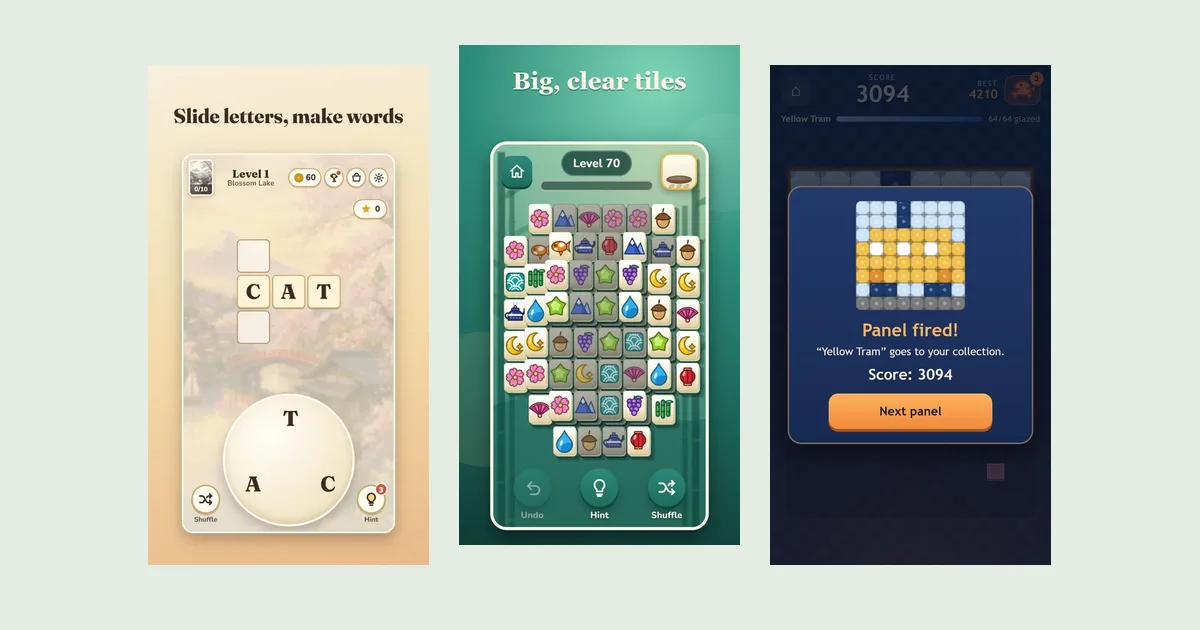
People are drawn to things that are almost finished. Psychologists describe a related idea in the Zeigarnik effect: unfinished tasks stay on our minds. Calm games use this kindly. In Wayfarer Words the next word is one slide away, and a watercolor postcard slowly appears every ten levels.
2. Small wins on the way to a bigger one
A level should end with a little bang, and a series of levels should end with a bigger one. Layering small and large rewards means there is always a good place to stop and an even better reason to continue.
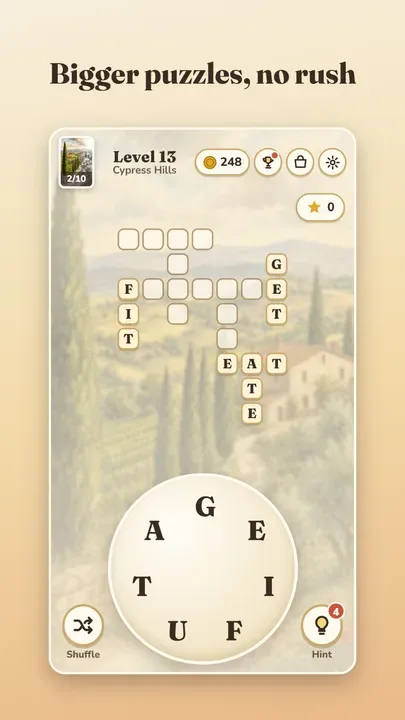
3. A gentle shape, not a wall
Difficulty that climbs forever feels like a hill that never ends. A saw-tooth curve works better: a few easy levels, a harder one, then a breather. You feel clever often, and the challenge is always fresh. Mahjong Petals grows a garden through the four seasons, so the same kind of puzzle keeps changing its look and its feel.
4. Four beats: introduce, develop, twist, reconcile
Many East Asian stories follow kishōtenketsu, a structure that builds without needing a conflict: introduce an idea, develop it, twist it, then bring it all together. Level designers often borrow it. A puzzle can teach a rule, let you use it, surprise you with a variation, and then show how it all fits. No enemy is needed.
5. A place that is yours
A small thing you are building makes returning feel like coming home. In Lighthouse Café you restore a seaside café piece by piece. In Kilnlight you fit tiles together to light the kiln. The game is the place, not just the task.
6. Stopping is always free
This is the part most games get wrong. If leaving costs you a streak, a life or a reward, you do not stay because you want to, you stay because you are afraid. A calm game lets you put it down at any second with nothing lost. The surprising result is that people come back more, because coming back is a choice.
Quick answers
Why do some games make you want to play one more round?
Because a goal is always close, small wins stack up, difficulty rises and falls gently and there is a place that feels like yours. Calm games do it without timers or punishment.
What is kishōtenketsu in game design?
A four part structure from East Asian storytelling (introduction, development, twist, reconciliation) that builds interest without conflict. Puzzle designers use it to shape levels.
Can a game be relaxing and still keep you playing?
Yes. Endless levels, gentle difficulty and no penalties for stopping can be as engaging as pressure, and they feel better.
Game developed by Kelvin Biffi: kelvinbiffi.com