
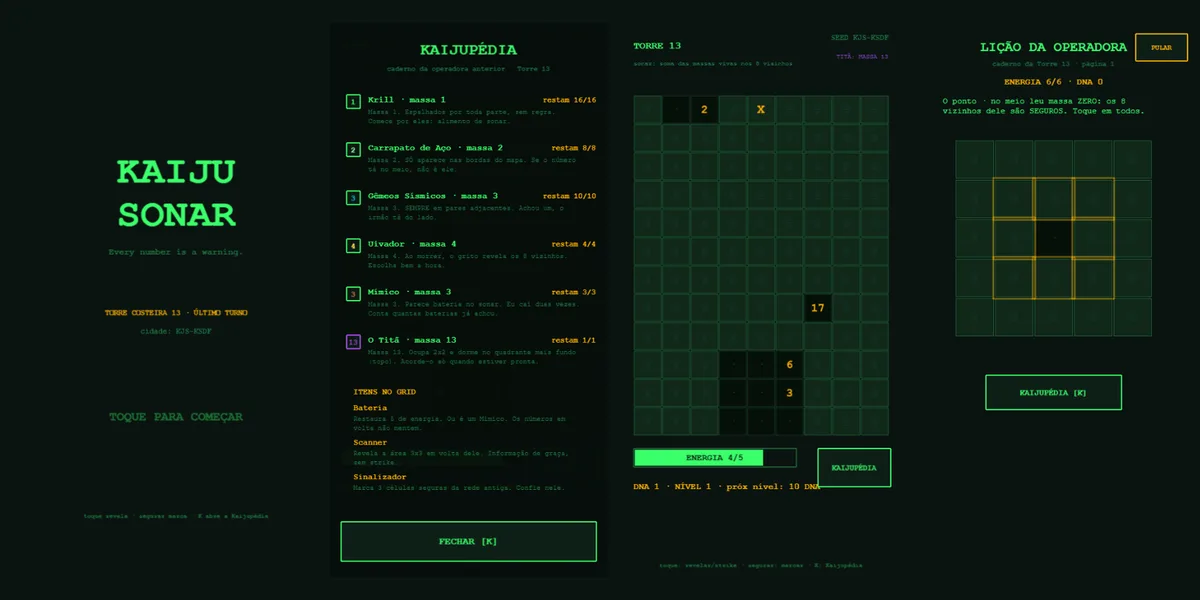
This one is a behind-the-scenes project, still in production. It is not out yet, and I would rather show you the work than promise a launch. The core loop is approved and playable; art, sound and the big finale are still ahead.
The idea: Minesweeper with a monster hiding in every number
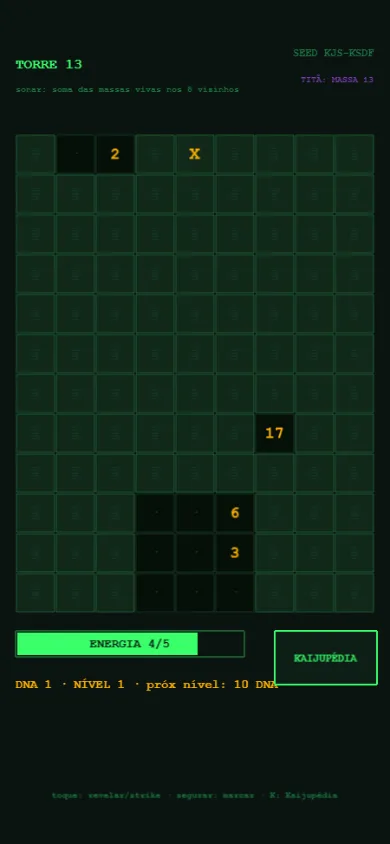
The idea came out of a trend-search report. A minesweeper hybrid with roguelite rules, the kind of game Dragonsweeper made popular in the browser, was a proven demand with a clear gap: the most common fan complaints were no real mobile support, a steep learning curve and flashing effects. So the pitch became a minesweeper that runs smoothly on a phone, teaches you how to play and does not hurt your eyes.
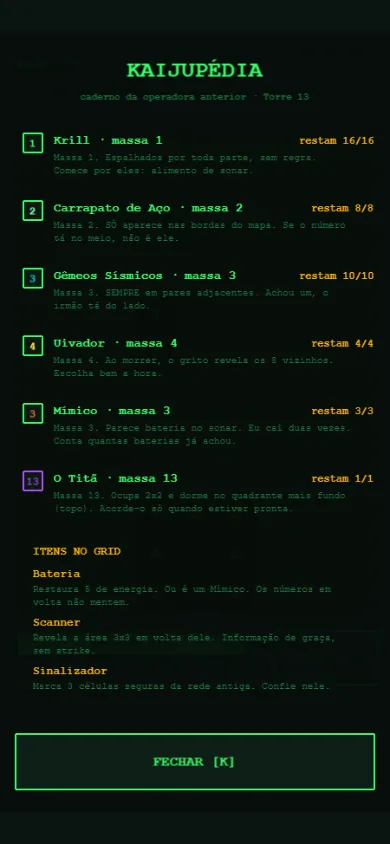
You are the last sonar operator of a coastal tower. Each cell shows the sum of the masses of everything alive around it. Kaiju are never drawn on the grid, only inferred. Krill, steel ticks, seismic twins, howlers, mimics and a Titan of mass 13 hide under the city, and the Kaijupedia, a notebook left by the previous operator, tells you how many of each remain.
The agents at work
I ran it through game-pm, with a rule that the technical heart comes first. A deduction game has one deadly risk: a map that forces you to guess. So the generator got its validator from day one, not later.
- game-dev wrote the Phaser 3 prototype and then reviewed its own code in review mode, catching three small issues: the Titan could never reach the deepest row, scene state was not reset between runs, and a tuning number was hardcoded instead of living in the data file.
- game-qa played with a "QA brain", a script that decides using only the public information on screen, never the hidden cells. It reproduced a serious failure twice, on two different seeds.
- game-balance built a headless simulator, which runs thousands of games with a cautious bot and a greedy bot, and tuned the energy curve over seven versions.
- game-ux played as a first-time player and gave the loop a 9 out of 10, and the average of the build a 6.9, because art, sound and onboarding did not exist yet.
- gdd-forge keeps the design document in line with the decisions the team makes along the way.
The failure that made the game better
QA rejected the first build. By pure deduction, with no guessing, the player reached a state where no safe move was left. The simulator confirmed it with numbers: with the original table, a win was mathematically impossible, zero percent. After many tuning rounds the win rate sat at about half, because it depended on the layout, not on the numbers.
The fix was structural. The generator now checks two things: that the map can be deduced from the information on screen, and that a cautious bot actually wins it without guessing. If not, it adds a few "old sensors" that start revealed, and if even that fails, it throws the layout away. Win rate in the simulator went to 100 percent, with generation averaging 40 milliseconds.
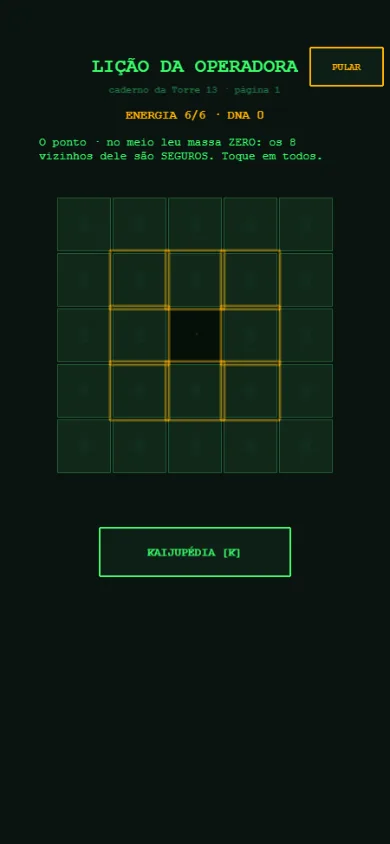
The second lesson came from me. I tried the prototype and told the team I did not know how to play, that it was hard. The tutorial, planned for later, moved to the top of the line, before art and before sound.
The AI toolbox
Two things are in play so far. Claude Code and its specialist agents write, test and review everything. ElevenLabs made the sonar ping, the signature sound of the game. Everything else on the list, such as pixel art portraits, a soundtrack and texts in three languages, is still ahead.
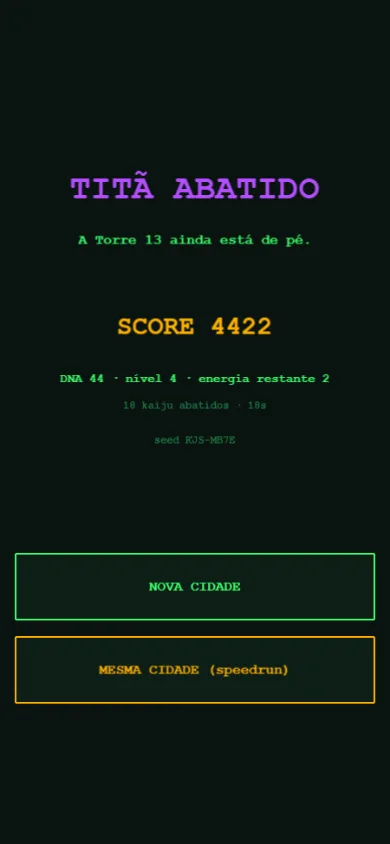
There is no store page yet, and I will not announce one before it is ready. If a deduction game with a monster in the numbers sounds like your kind of thing, keep an eye on the blog.
Game developed by Kelvin Biffi: kelvinbiffi.com
Sound effects made with ElevenLabs.