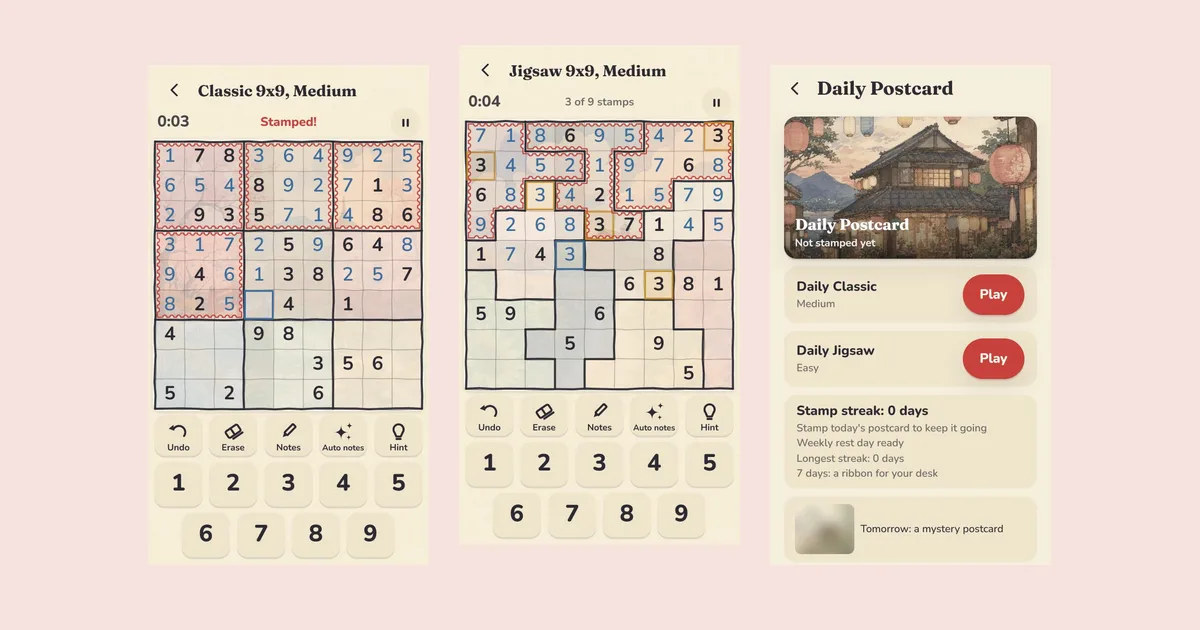
Sudoku looks like a math test and plays like a gentle detective story. You never add anything up. The only rule is that each row, each column and each box holds the digits 1 to 9 exactly once (Wikipedia has the history). A well made puzzle can always be solved by pure logic, so if you feel stuck, there is a next step you have not spotted yet. Here are the seven steps we use, in the order we use them.
1. Scan before you write
Pick a digit, say 5, and look at where it already appears. Every 5 blocks its row, its column and its box. Look for a box where only one cell is left that is not blocked. That cell is a 5. Repeat for each digit from 1 to 9. This one habit solves most easy puzzles.
2. Hunt for the fullest row, column or box
A group with seven or eight digits already placed is a gift. Name the missing digits, then check which cell can take each one. This is the "naked single": a cell that has only one possible digit left.
3. Learn the hidden single
A hidden single is a digit that has only one place left in a row, column or box, even if that cell could also hold other digits. Scanning for it is the same move as step 1, seen from the group instead of the digit.
4. Use pencil notes the moment it gets tight
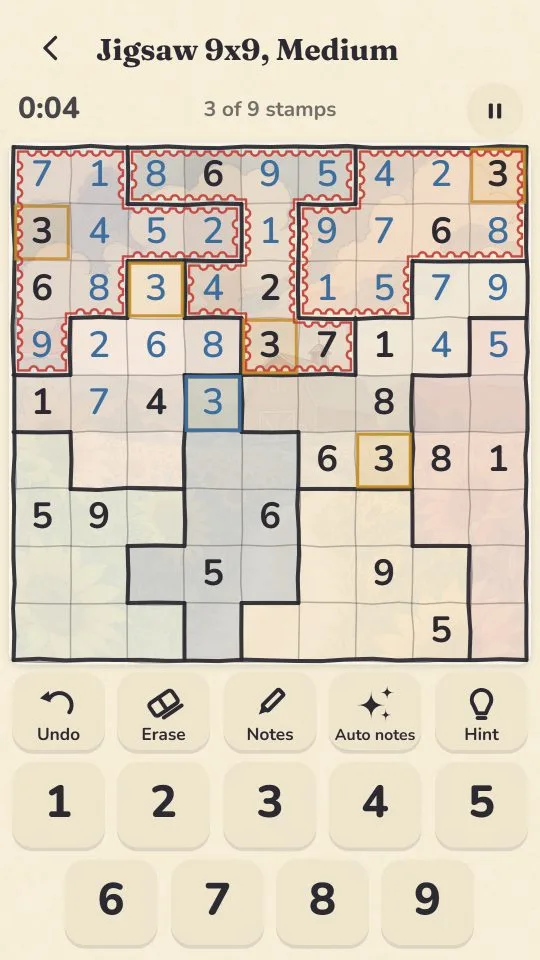
When scanning stops working, write small candidates in each cell. In Postcard Sudoku there is a Notes button and an Auto notes option that fills them in for you, so you can practice the logic without the bookkeeping. Every time you place a digit, erase it from the notes of its row, column and box.
5. Look for pairs
If two cells in the same group can only be 3 or 7, those two digits belong to those two cells. You do not know which is which yet, but you can remove 3 and 7 from every other cell in that group. Pairs unlock many medium puzzles.
6. Never guess, back up instead
Guessing feels fast and ruins the calm. If you reach a contradiction, undo to the last place you were sure, then look again for a single or a pair you missed. The undo button is part of the strategy, not a failure.
7. Try the jigsaw twist
In jigsaw sudoku the boxes are irregular shapes instead of 3 by 3 squares. Rows and columns still work the same, but the regions wander. Start every scan with the region, because it is the part your eyes are least used to. You can play today's jigsaw free in the browser at k3gamesstudio.com/sudoku and then find the same mode in the app.
A comfortable way to practice
- Start with 6x6 boards: the same logic, a quarter of the work.
- Play one puzzle a day: a short daily habit beats a long weekend session.
- Turn off the timer in your head: finishing calmly is the goal.
- Play without ads: Postcard Sudoku has none, and works offline.
Quick answers
How do I start a sudoku as a beginner?
Pick a digit and look at where it already appears. Each copy blocks its row, column and box, so look for a box or row with only one free place for that digit. Repeat for all nine digits.
Do I ever need to guess in sudoku?
No. A well made sudoku can be solved with logic alone. If you feel stuck, use pencil notes and look for pairs.
What is jigsaw sudoku?
A sudoku where the boxes are irregular shapes instead of 3 by 3 squares. Rows, columns and shapes must each contain the digits 1 to 9 once.
Game developed by Kelvin Biffi: kelvinbiffi.com